
 Español
 SELECTED CAPABILITY
Unified customer records
Keep one customer record with current identity, company, relationship and ownership details available to the team.
Revenue teams and account owners
We are loading this page’s information and tools.
Operational product available for evaluation and implementation scoping.
One operating memory for every customer relationship.

Revenue teams and account owners
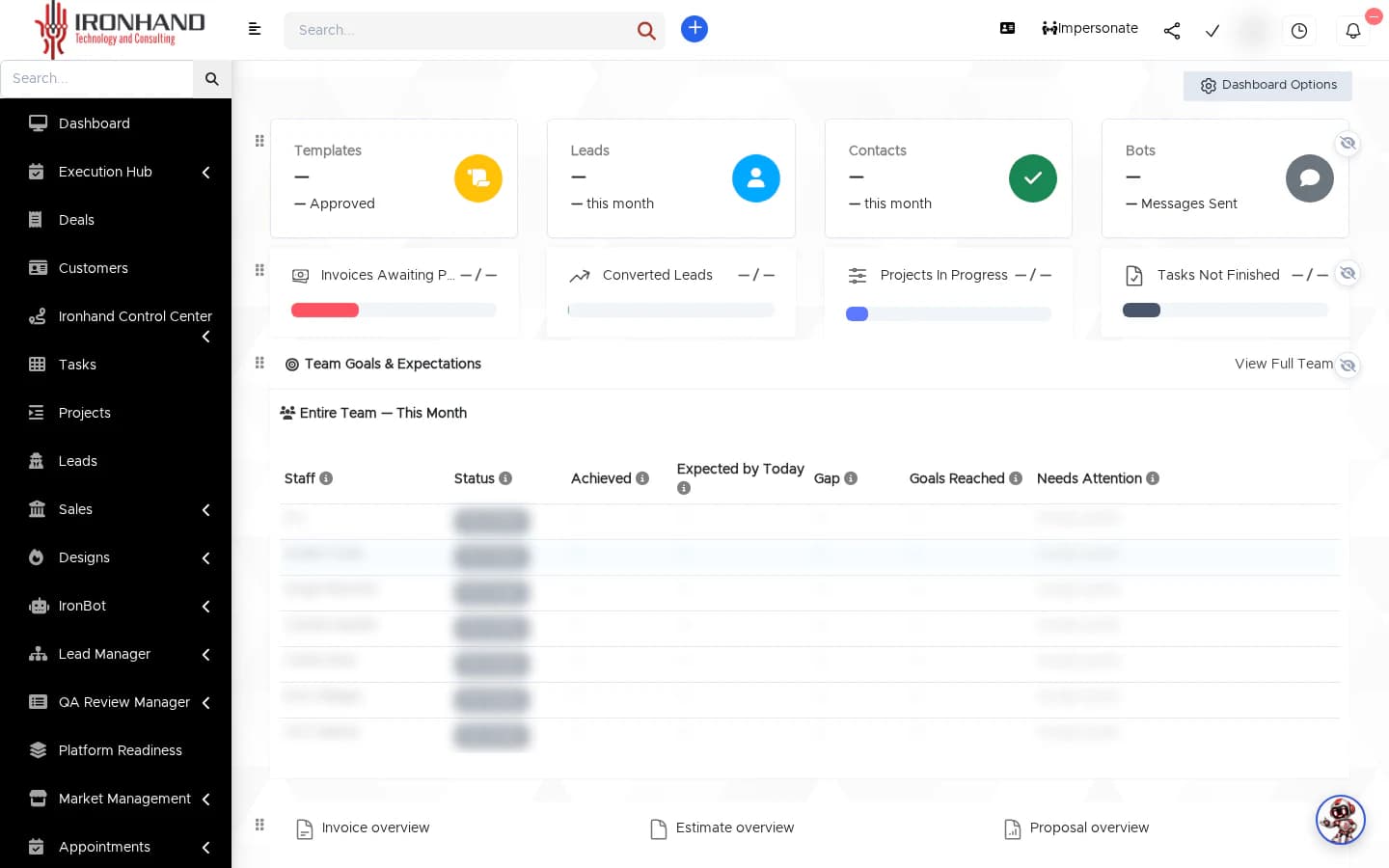
Privacy-obscured operating dashboard showing leads, contacts, tasks, projects, follow-up and team reporting.
SELECTED CAPABILITYKeep one customer record with current identity, company, relationship and ownership details available to the team.
Final fit depends on the workflow, users, permissions and systems already working in your company.
This question guides discovery; we do not assume the platform is necessary until the cause is confirmed.
CRM Pipeline Launch is a defined public phase-one package. Its approved planning range supports budgeting; the package-specific proposal confirms the binding price after the assumptions are validated.
A small revenue team replacing spreadsheets with one accountable sales process.
This package defines what the phase-one purchase is meant to accomplish. The range is an owner-authorized planning example under the published assumptions; availability, final price, tax and terms become binding only in a signed proposal.Planning window: 3–5 weeks after the data sample, users, permissions and team availability are confirmed.
Timing changes when records need repair, access is delayed, custom integration is added or the agreed pipeline changes.Launch support covers the configured pipeline, permissions, included import and agreed acceptance checks.
Email and scheduled remote support are available Monday–Friday, 9:00–17:00 Central Time. The proposal names the escalation route. Planning target: initial response within one business day. A signed proposal controls any different or severity-specific commitment.Remote launch training for the named phase-one users is included.
One structured CSV import is included; data repair and additional migrations are separate. Continuing administration and optimization are not included unless the proposal adds them expressly.IronhandCRM has 9 distinct capabilities recorded specifically in its product record. The proposal confirms which capabilities are included in the contracted scope.
Shared context, history and clear record ownership.
Pipeline, next actions and coordinated execution.
Reporting, documents and team accountability.
No capability on this page is purchased, configured, or connected until it appears in an accepted proposal.
Confirm enabled modules, user count, role permissions, teams, pipelines, and record ownership.
Name source systems, fields, history, deduplication rules, attachments, and the records that stay elsewhere.
Confirm stages, assignments, reminders, escalation, dashboards, exports, and evidence needed for management review.
Define test evidence, launch acceptance, support channels, coverage hours, response targets, maintenance, and updates.
The demo and proposal distinguish what is included in the plan, optional configuration, separate modules or add-ons, and integrations supplied under an agreed scope.
Capture each relationship with its commercial context. Read pipeline movement from accountable follow-up.
These relationships help explore an architecture. Only technical dependencies identified by current rules are treated as requirements; companions and catalog associations are neither included nor integrated by default. The proposal confirms every connection.
Create a predictable growth engine.
Catalog association; the proposal confirms components and connections.SOLUTION GROUPINGTurn more opportunities into customers.
Catalog association; the proposal confirms components and connections.PLATFORMSales, inventory and operating visibility at the point of action.
Catalog association · integration unconfirmedBlueprint reviews the problem, its cost and your constraints in the context of IronhandCRM. You receive a priority, phase-one scope and sequence. It shows a range only when buyer inputs and approved pricing cover the full scope; otherwise it identifies what is missing.